
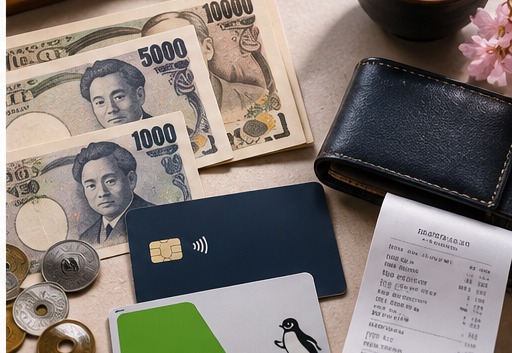
Cards are widely useful
Japan National Tourism Organization says international credit and debit cards are generally accepted, especially at major hotels, department stores, shopping centres and restaurants in urban areas. Visa, JCB and Mastercard are among the widely accepted networks.
Why cash still matters
Smaller shops, countryside businesses and some independent accommodation may still be cash-only. It is also useful to have yen for situations where a foreign card fails or a machine only accepts cash.
Suica and PASMO make daily travel easier
Prepaid IC cards such as Suica and PASMO can be used across much of Japan for trains and buses and also for many convenience stores, vending machines and small purchases. For most first-time visitors, that is more convenient than buying individual transport tickets repeatedly.
Do not rely on one payment method
A good setup is simple: one primary international card, a backup card kept separately, an IC transport card, and a modest amount of cash. That gives you options without carrying a large amount of yen.
What we would do on arrival
Set up an IC card early, keep enough cash for a day or two of small purchases, and use your card for hotels, larger restaurants and shopping where accepted.
What to do after you land
For Japan, the easiest arrival is usually: data first, yen second, transport card/rail plan third, taxi only if it genuinely makes sense for your luggage or arrival time.
SIM / eSIM
At Haneda Terminal 3, prepaid SIM and Wi-Fi services are available in the 2F Arrival Lobby. Narita has SIM-card counters and vending machines across the international terminals. An eSIM installed before departure is the quickest option if your phone supports it.
Money & cards
Haneda Terminal 3 has 24-hour currency exchange in the 2F Arrival Lobby. Narita has ATMs and exchange counters in the arrival areas of Terminals 1-3. Seven Bank and other international-card ATMs are useful for withdrawing yen instead of carrying a large amount of cash.
Airport taxi / transfer
Haneda T3: follow Taxi signs from the 2F access hall down to the 1F taxi area; general taxis use Stop 21. App-dispatched rides use the dedicated pickup shown in the app (currently P5 Parking, 8F for T3). Narita has signed taxi stands at every terminal, including T1 Stand 15 and T2 Stands 28/31-A.
Your first 15 minutes
Turn on data, withdraw a modest amount of yen, set up your IC/transit payment if needed, then use rail/monorail for most city trips unless luggage, late arrival or accessibility makes a taxi the better choice.
Travel information can change. We review practical details regularly and recommend checking official sources again before departure.